

The Global Rate Reset: A New Economic Era
Global interest rates are rising at a pace not seen in decades, transforming the economic landscape for governments, businesses, and consumers alike. The persistent climb in long-term borrowing costs is no longer a fleeting market event—it’s a fundamental shift that could alter the way the world finances its future.
Why Borrowing Costs Matter
The surge in global interest rates is more than just a financial headline. It impacts every corner of the economy. As global interest rates rise, the cost of financing large-scale investments increases. This makes it harder for companies to expand, for governments to fund infrastructure, and for individuals to buy homes or cars. Higher borrowing costs can cool economic growth and force tough choices about spending and investment priorities.
Brookings Institution fellow Robin Brooks highlighted the gravity of the situation, stating, “Global bond markets have caught on fire. … Reckless fiscal policy is catching up with governments.” Brooks further noted that investors now expect U.S. rates to remain elevated for years, exceeding previous forecasts even from the era of aggressive rate hikes in 2022.
Record-Setting Yields Across the Globe
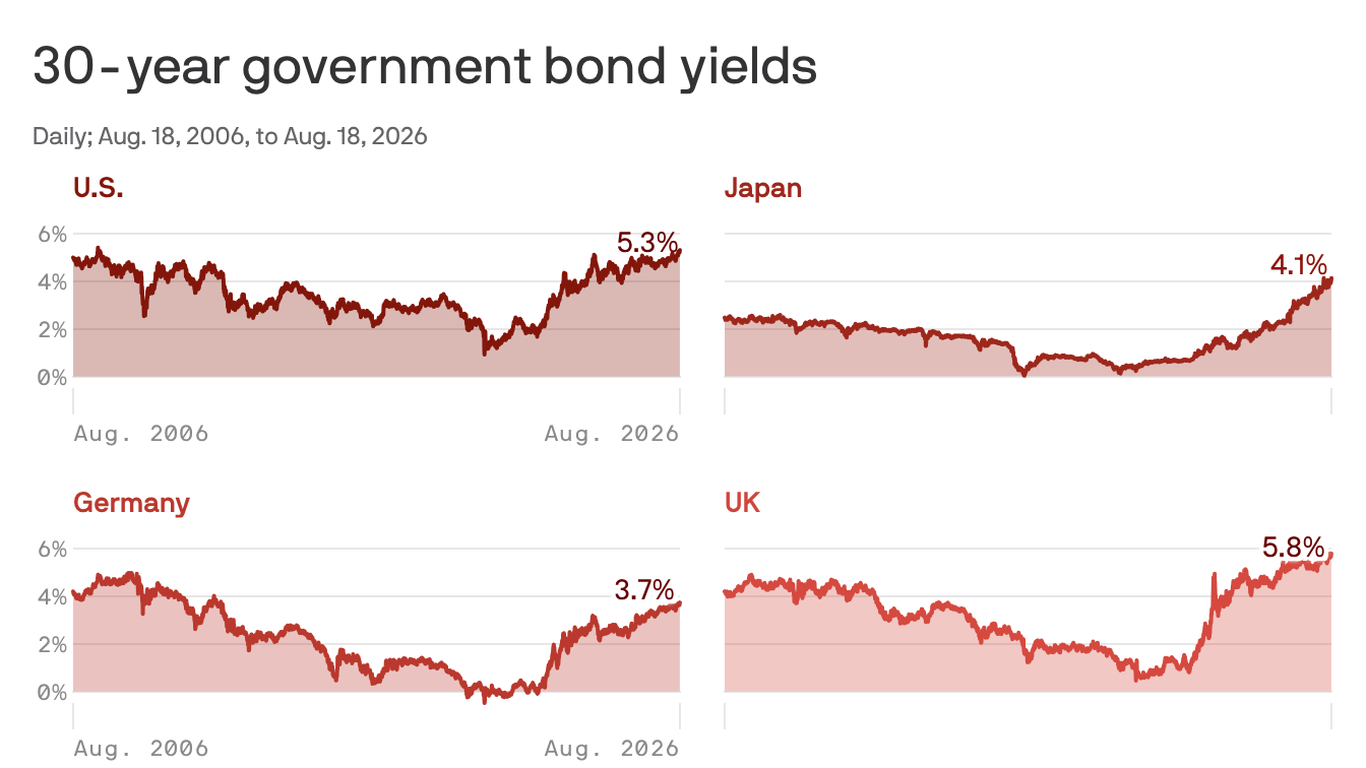
The rise in global interest rates is a truly international phenomenon. Recent data reveals long-term yields reaching heights not seen in years—and in some cases, decades:
- United States: The 30-year Treasury yield soared to 5.3%, its highest since June 2007.
- Japan: The 30-year government bond yield reached 4.1%, approaching a record high.
- France: Yields hit 4.9%, the highest level since 2008.
- Germany: Comparable rates rose to 3.7%, the most since the euro-area debt crisis in 2011.
- Britain: Yields climbed to 5.8%, near the highest since 1998.
These numbers signal a seismic shift in the cost of money across advanced economies.
Underlying Forces Driving Rate Increases
Several factors are fueling the relentless rise in global interest rates. While the Middle East conflict has recently pushed oil prices above $90 per barrel and reignited inflation fears, the trend of rising rates predates these events. Other key drivers include:
- Massive Government Borrowing: As countries fund ambitious projects and social programs, more bonds compete for investors’ attention, pushing yields up.
- Corporate Debt for AI Expansion: Tech giants are investing heavily in data centers, chips, and infrastructure, increasing demand for capital.
- Demographic Pressures: Aging populations are increasing costs for pensions and healthcare, straining public finances.
- Geopolitical Instability: Wars and global tensions are prompting higher defense and energy spending.
According to Anshul Pradhan, head of U.S. rates at Barclays, “These are not new forces, and the rise in long-term yields has been gradual rather than sudden.” Despite recent soft economic data in the U.S.—including weak consumer spending, a disappointing jobs report, and lower inflation—yields have continued to climb, showing the strength and persistence of these underlying pressures.
Economic Friction and the Price of Money
The timing of this surge in global interest rates is especially challenging. The world’s major economies are undertaking vast transformations—from the digital revolution driven by artificial intelligence to the rebuilding of energy systems in response to geopolitical threats. Yet, these ambitions now face the headwind of rising borrowing costs.
As more entities compete for capital, the price of money is soaring. This could lead to reduced business investment, slower hiring, and increased costs for households. Governments may find less fiscal space to respond to future crises or invest in long-term growth.
Risks and the Road Ahead
Higher global interest rates also bring heightened risks. Sudden or sustained increases can expose vulnerabilities, as seen in 2023’s regional bank failures in the U.S. when surging rates hammered the value of Silicon Valley Bank’s bond portfolio. These events underscore the fragility of a system undergoing rapid change.
The bottom line: The world is entering a period where cheap money is no longer guaranteed. Financing ambitious projects and maintaining economic stability will require adaptation to this new environment. Policymakers, investors, and consumers must all adjust their expectations as the era of ultra-low rates comes to an end.
This article is inspired by content from Original Source. It has been rephrased for originality. Images are credited to the original source.