

Guernsey Seminar Spotlights Climate Finance Innovation
At a recent seminar hosted by Guernsey Finance, global financial and humanitarian experts gathered to discuss the transformative potential of blended finance in addressing climate change. Held as part of the Guernsey Sustainable Finance Seminar series, the event emphasized the strategic fusion of public and private capital to drive sustainable initiatives, particularly in vulnerable regions.
Understanding Blended Finance
Blended finance is defined by the London School of Economics as the strategic use of public funds to attract private investment, especially in developing countries. This approach combines different sources of finance—such as government grants, development finance, insurance, and commercial capital—to mitigate investment risks and expand the scope of climate-resilient projects.
“Many transactions cannot occur without the financial engineering that brings in different forms of capital to de-risk private investor appetites,” said Justin Sykes, managing director of Guernsey-based Innovest Advisory. “Blended finance is what allows us to move from proof-of-concept to scalable solutions.”
Case Studies Demonstrate Real-World Impact
Sykes shared several examples during the panel discussion. One involved an NGO in the Philippines—one of the world’s most disaster-prone nations—working to make homes more resilient to climate impacts. Despite successfully upgrading 1,500 homes, the organization faced limited access to further financing due to credit risks. “An insurance product can help to de-risk this and raise finance from impact investors who previously would not participate,” Sykes explained.
Another project involved launching a green bond with a West African utility company. What set this initiative apart was the backing of a UK government guarantee fund, making it more attractive to UK pension funds willing to explore emerging market investments. “That is a game changer,” Sykes added.
Insurance Sector Plays a Crucial Role
Mike Pickard, Director of Global (Re)insurance at ILS Management, highlighted the importance of reinsurance in supporting countries like Ukraine, where insuring grain exports has become a challenge. “We work with the European Bank for Reconstruction and Development (EBRD) to provide more risk cover. They need insurance, but firms won’t insure them. We find mechanisms to provide reinsurance,” he noted.
Guernsey’s regulatory flexibility has enabled the creation of such structures. “We built a structure with the EBRD, with insurance underwritten and guaranteed by them. We are looking to replicate this model,” Pickard said. “Guernsey has enabled us to have this blended finance structure.”
Bridging the Humanitarian and Private Sectors
Petra Demarin, senior advisor for strategic partnerships at the International Federation of the Red Cross and Red Crescent Societies, emphasized the growing demand for disaster relief funding amid limited government resources. “Natural disasters are funded almost exclusively by governments, so we are required to do more with less and are looking at new approaches like blended finance,” she said.
However, Demarin acknowledged the cultural and ethical divide between the humanitarian and private sectors. “They don’t speak the same language. And the possibility of making money out of vulnerable people is terrifying,” she admitted. Yet blended finance offers the potential to bridge that gap by creating sustainable, commercially viable models for aid delivery.
“We want to focus grant funding in areas that aren’t commercially viable, such as Palestine, and use different financing in places like Nigeria where there are commercial opportunities,” Demarin explained. “It takes time to do this. This type of engagement is potentially beneficial for us.”
Guernsey as a Hub for Sustainable Finance
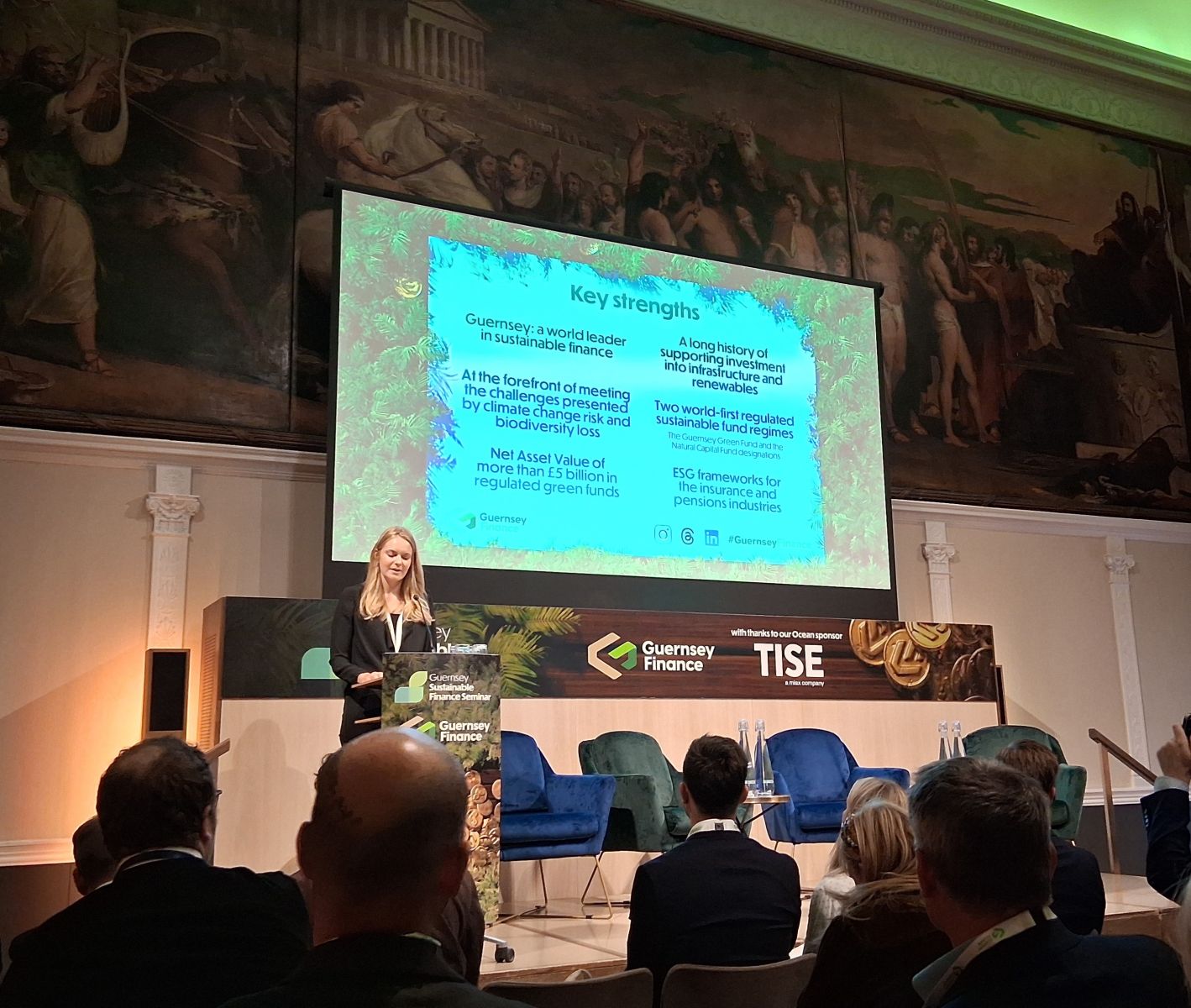
Stephanie Glover, strategy and sustainable finance director at Guernsey Finance, underscored the island’s role as a global leader in green finance. “Sustainable finance is a golden thread running through every part of Guernsey’s financial services industry,” she said. “We pioneered two world-first regulated sustainable fund regimes, now with a combined net asset value exceeding £5 billion, alongside robust ESG frameworks.”
Glover added that the seminar provided a valuable platform for knowledge sharing and partnership-building. “Every time we come together to share knowledge, debate solutions and form new partnerships, we strengthen Guernsey’s role in delivering climate-positive finance.”
Guernsey has made a name for itself by offering flexible, responsive structures and regulatory support tailored to innovative financial models. As climate change continues to pose global challenges, the island’s commitment to sustainable finance positions it as a key partner in achieving net zero objectives and supporting climate adaptation globally.
This article is inspired by content from Original Source. It has been rephrased for originality. Images are credited to the original source.