

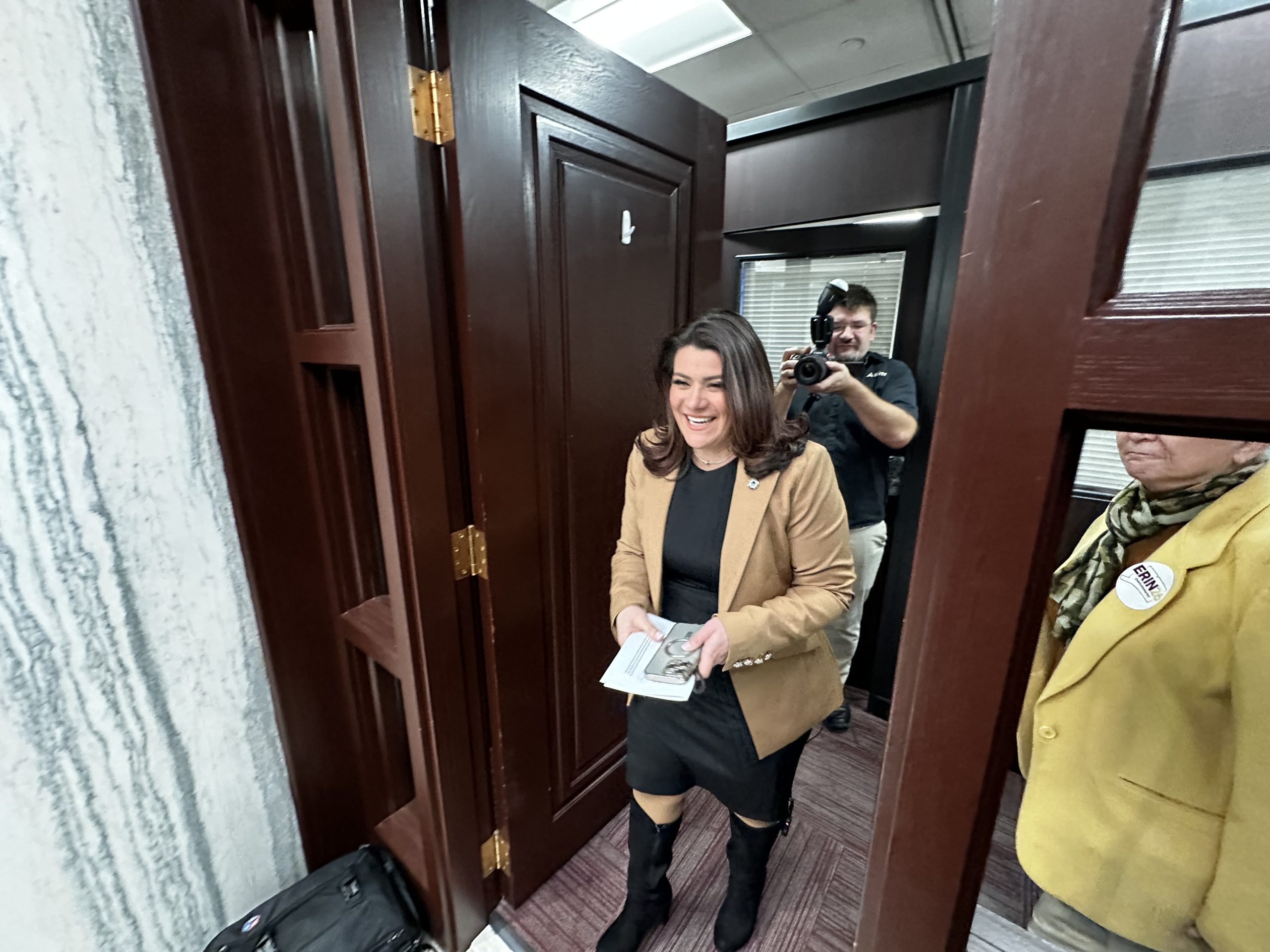
Erin Stewart Achieves Early Milestone in Gubernatorial Race
Republican gubernatorial candidate Erin Stewart has become the earliest contender in Connecticut history to qualify for public campaign financing through the Citizens’ Election Program, a significant step in her bid for the state’s highest office.
The State Elections Enforcement Commission (SEEC) unanimously approved Stewart’s application on Wednesday, granting her an initial $806,875 convention grant. If she secures the GOP nomination, she will be eligible for an additional $15.4 million in public funding.
“It’s a statement of credibility and broad public support,” said John Healey, Stewart’s general consultant and senior advisor. “This gives the campaign the ability to staff up and run a full-fledged field operation.”
New Rules Level the Playing Field
Stewart’s early qualification is made possible by recent changes to Connecticut’s campaign finance laws. Previously, public funds could only be accessed after candidates qualified for a primary at a May nominating convention. The 2022 revisions now allow candidates to receive an advance upon qualification, significantly improving their ability to compete early in the race.
Under the updated system, the primary grant has increased from $1.3 million to $3.2 million, and the general election grant rose from $6.5 million to $15.4 million. The reforms aim to provide more equitable opportunities for publicly funded candidates against self-financed opponents who historically had a head start in campaign spending.
In 2018, Republican newcomer Bob Stefanowski began spending heavily in January, months before publicly financed candidates Mark Boughton and Tim Herbst received their grants. Stewart’s early funding helps avoid similar disadvantages.
A Strategic and Disciplined Campaign
Stewart, 38, served as mayor of New Britain for 12 years and chose not to seek reelection in 2025. Instead, she focused on a calculated path toward running for governor. She began raising qualifying funds as early as January 2025 through an exploratory committee, officially declaring her candidacy in November after the municipal elections.
Her strategic approach paid off. Stewart submitted her public financing application in December, and following an audit to verify all qualifying contributions, she was approved in early January. She ultimately raised $287,153 in eligible small-dollar donations, far surpassing the $250,000 threshold required under the program.
“She posted a very strong fundraising record throughout the course of the year,” Healey added. “She has ticked every box, despite the naysayers saying, ‘She’ll hit a wall at some point.’”
Competition Heats Up in the Republican Field
Stewart faces competition within her party. State Senator Ryan Fazio, 35, of Greenwich, also intends to pursue public financing and claims to have reached the $250,000 benchmark. His campaign has stated that Fazio’s quarterly finance report, due on January 10, will reflect this achievement, noting he did it “faster than any other statewide campaign.”
Fazio launched his campaign in August, giving him several months head start over Stewart, who formally entered the race in November. However, Stewart’s early fundraising through the exploratory committee allowed her to make up ground quickly.
Another potential Republican contender is Betsy McCaughey, a 77-year-old Newsmax host and former New York lieutenant governor. Although she has not officially entered the race, she has signaled strong interest to party members.
Public Financing in Connecticut Politics
Connecticut’s Citizens’ Election Program was established following a 2004 corruption scandal involving then-Governor John G. Rowland. Designed to promote transparency and reduce the influence of large donors, the system is widely used by state legislative candidates.
Participants must adhere to strict spending limits and are barred from accepting contributions from state contractors, regardless of whether they utilize public financing.
In the past, the program played a central role in gubernatorial campaigns. Governor Dannel P. Malloy won office in 2010 using public funds and was re-elected in 2014 under the same system. However, recent elections have seen a shift.
Challenges from Self-Funded Candidates
The significance of public financing has waned in recent gubernatorial races. In 2018 and again in 2022, Democrat Ned Lamont and Republican Bob Stefanowski opted out of the program. Lamont spent $25.7 million to win re-election in 2022, while Stefanowski’s campaign expenditures reached $14.5 million.
In the final five weeks of the 2022 campaign alone, Lamont spent $8 million on television advertising, exceeding the total amount allowed for an entire campaign under the Citizens’ Election Program. This disparity has prompted concerns about the relevance and competitiveness of publicly funded campaigns.
With the latest reforms and Stewart’s early qualification, the program may be poised for a resurgence—at least among candidates who seek to demonstrate grassroots support and fiscal discipline.
This article is inspired by content from Original Source. It has been rephrased for originality. Images are credited to the original source.