

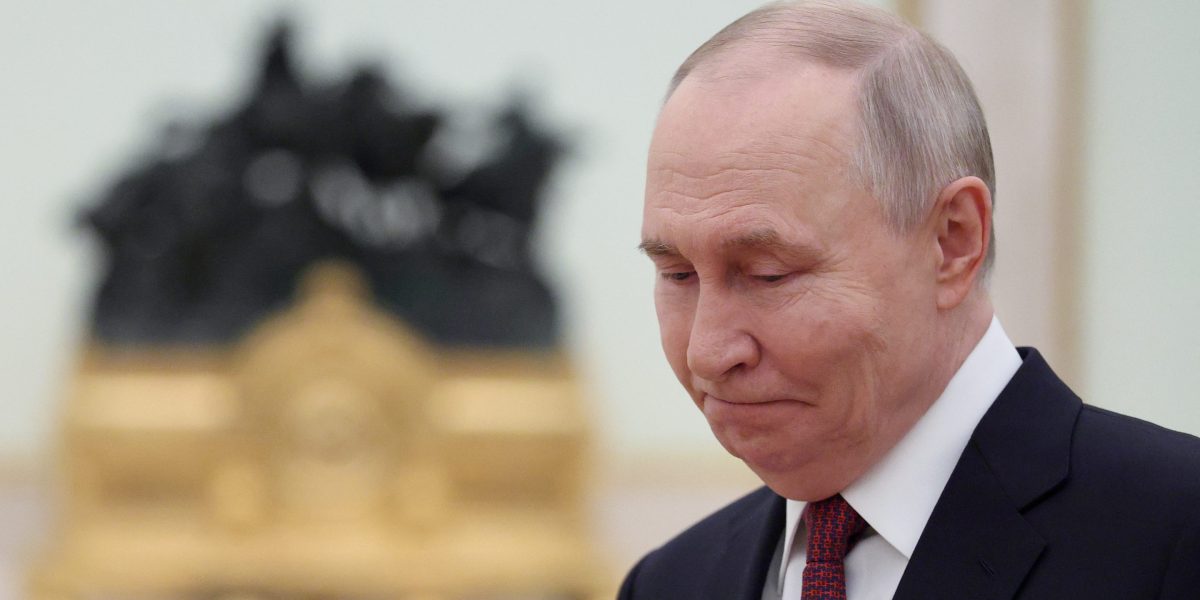
Mounting Economic Pressures Inside Russia
Russian officials are increasingly concerned that the nation could plunge into a financial crisis as early as this summer, according to recent reports. As President Vladimir Putin continues to escalate the war in Ukraine, the economic toll on Russia is becoming unsustainable. Senior government sources have expressed alarm over plummeting oil revenues and a ballooning budget deficit, despite tax hikes aimed at increasing state income.
Oil revenues, Russia’s primary source of income, dropped by 50% in January compared to the same month a year earlier. The collapse in crude sales has forced the Kremlin to tap into its sovereign wealth fund, which itself is now running dangerously low. Meanwhile, inflation is rising, businesses are shuttering, and thousands of workers are losing their jobs—painting a grim picture of a country under severe financial strain.
Warnings of an Impending Banking Crisis
Internal warnings are growing louder. In December, a Russian official told the Washington Post that a banking or nonpayment crisis was a real possibility. The official, speaking anonymously, expressed fears about the war dragging on and escalating further. The head of the Russian Union of Industrialists and Entrepreneurs echoed those sentiments in June, stating many companies were nearing default.
Compounding the problem, interest rates remain high due to persistent inflation, making it difficult for consumers and businesses to access affordable credit. The Center for Macroeconomic Analysis and Short-Term Forecasting, a government-affiliated think tank, warned that the country could face a full-blown banking crisis by October if the loan default rate increases and depositors begin withdrawing funds en masse.
Impact on Russian Society and Industry
The economic downturn is already being felt in everyday life. A Moscow business executive told reporters that the crisis could hit within three to four months, citing the closure of numerous restaurants and widespread layoffs. With consumer spending in decline and companies struggling to stay afloat, many workers are seeing reduced hours, unpaid wages, or outright furloughs. This, in turn, is causing a spike in loan defaults and fear of a credit market collapse.
“The Russian economy has entered the brink of stagflation for the first time since early 2023,” wrote Dmitry Belousov, head of the think tank, in a report cited by the Financial Times. The term ‘stagflation’ refers to the dangerous mix of stagnant growth and high inflation—an economic scenario that can be extremely difficult to reverse.
International Sanctions and Global Oil Market Effects
Western sanctions have exacerbated Russia’s economic struggles. The United States has imposed penalties on major Russian oil firms Rosneft and Lukoil, while Europe is now considering sanctions on the “shadow fleet” of tankers used by Moscow to export crude. These measures have forced Russia to sell its oil at steep discounts, and falling global oil prices have only worsened the situation.
Despite declining revenues, the Kremlin continues to allocate massive resources to military spending and recruitment incentives. Analysts say that this spending is unsustainable without further revenue sources or external financing, both of which seem increasingly unlikely under the current sanctions regime.
The War That Can’t End
Many observers believe that Putin cannot afford to end the war, not just politically but economically. The conflict has already cost Russia dearly in human lives, with estimates suggesting over 1.2 million Russian troops killed or wounded since the invasion began. NATO Secretary General Mark Rutte reported that 30,000 Russian soldiers died in December alone—an average of 1,000 per day—yet these sacrifices have yielded minimal territorial gains.
European leaders argue that Russia is losing strategically. Ukraine is moving closer to European Union membership, NATO has expanded, and European countries have significantly increased their defense budgets. “Russia has to continue the war because this war is too big for Putin to fail,” said Finnish President Alexander Stubb at the World Economic Forum last month.
Stalled Diplomacy and Future Uncertainty
While there have been intermittent diplomatic efforts, significant breakthroughs remain elusive. Russian, Ukrainian, and U.S. officials recently concluded two days of talks in Abu Dhabi with little progress. Ukrainian President Volodymyr Zelensky stated that the U.S. wants the war to end by June and has proposed a new round of negotiations to be held in the United States, possibly in Miami.
“America proposed for the first time that the two negotiating teams—Ukraine and Russia—meet in the United States of America, probably in Miami, in a week. We confirmed our participation,” Zelensky said in a statement.
Conclusion
With the Russian economy teetering on the edge and the war in Ukraine showing no signs of abating, the coming months could prove critical for the Kremlin. Financial instability, combined with international isolation and military setbacks, has left Russia facing one of its most challenging periods in recent history.
This article is inspired by content from Original Source. It has been rephrased for originality. Images are credited to the original source.