

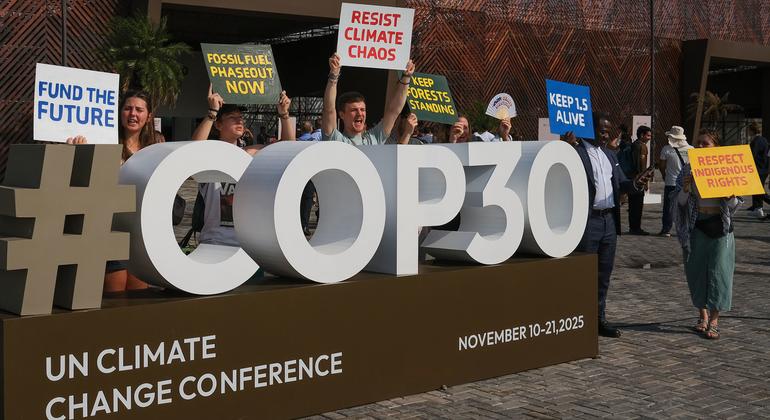
Global Leaders Reach Climate Finance Agreement at COP30
In a landmark decision at the COP30 climate summit held in Belém, Brazil, global leaders endorsed a sweeping climate finance package aimed at accelerating the implementation of the Paris Agreement. The agreement focuses on financial mobilization, adaptation strategies, and combating climate disinformation. However, it stops short of committing to a definitive transition away from fossil fuels, a key concern for many nations and environmental advocates.
Ambitious Financial Commitments
The summit concluded with a strong emphasis on scaling up financial support for climate action. The key financial provisions include a pledge to mobilize $1.3 trillion annually by 2035, with developed countries taking the lead. Adaptation finance will be doubled by 2025 and tripled by 2035. Additionally, the Loss and Damage Fund—first agreed upon at COP28—has been officially operationalized, establishing a clear replenishment cycle.
Two new initiatives were also launched: the Global Implementation Accelerator and the Belém Mission to 1.5°C. These are designed to help countries meet their nationally determined contributions (NDCs) and adaptation plans more effectively.
Addressing Climate Disinformation
For the first time in COP history, the final decision document addresses the growing threat of climate disinformation. Delegates agreed to promote information integrity and counteract false narratives that undermine science-based climate action. This move aligns with Brazilian President Luiz Inácio Lula da Silva’s opening declaration that COP30 would be remembered as “the COP of truth.”
While this step is seen as a vital measure to protect public trust, some attendees expressed disappointment over the lack of a firm stance on phasing out fossil fuels—highlighting the ongoing political challenges in global energy negotiations.
Gaps in the Agreement
Despite the financial commitments, the final agreement notably omits explicit language on transitioning away from fossil fuels. This omission has drawn criticism from several parties, including South American and European Union negotiators, as well as civil society organizations. Fossil fuel combustion remains the largest contributor to greenhouse gas emissions and climate change. The absence of a clear plan to reduce dependency on these energy sources has left many stakeholders concerned.
Two New Roadmaps on the Horizon
In a bid to address some of the concerns raised, COP30 President André Corrêa do Lago announced the development of two new roadmaps. One will focus on halting and reversing deforestation, while the other aims to guide a just and equitable transition away from fossil fuels. These initiatives are intended to mobilize resources and support sustainable development without leaving vulnerable communities behind.
“I know the youth and civil society will demand more from us,” said do Lago during the closing session. “I want to reaffirm that I will try not to disappoint you during my presidency.”
Challenges on the Road to Consensus
The path to reaching this agreement was far from smooth. Indigenous groups held protests demanding greater protections for the Amazon rainforest, and a fire in the main conference hall disrupted key negotiations late in the summit. Delegates worked through the night to resolve differences, particularly on finance and ambition, with the Brazilian presidency playing a crucial role in steering discussions toward a workable outcome.
Much of the focus was on building on the agreements reached at previous COPs, particularly on financing mechanisms and implementation strategies.
UN Chief Reaffirms Multilateralism
From the G20 Summit in Johannesburg, UN Secretary-General António Guterres praised the achievements of COP30, declaring that the summit demonstrated that multilateralism is still alive. He acknowledged the launch of the Global Implementation Accelerator and the reaffirmation of the UAE Consensus, which includes a commitment to a just and equitable energy transition.
However, Guterres was also candid about the limitations of the summit’s outcomes. “COPs are consensus-based – and in a period of geopolitical divides, consensus is ever harder to reach. I cannot pretend that COP30 has delivered everything that is needed,” he said. He emphasized that without deep and rapid emission cuts, the world is likely to overshoot the Paris Agreement’s 1.5°C target, which would have devastating consequences.
Looking Ahead
As COP30 concludes, the message is clear: while significant strides have been made in climate finance and implementation, the battle is far from over. The absence of a definitive fossil fuel transition plan underscores the complexities of international climate diplomacy. Yet, the commitments made in Belém lay critical groundwork for future action.
“COP30 is over, but the work is not,” Guterres reminded the global community. “Do not give up. History – and the United Nations – are on your side.”
This article is inspired by content from Original Source. It has been rephrased for originality. Images are credited to the original source.