

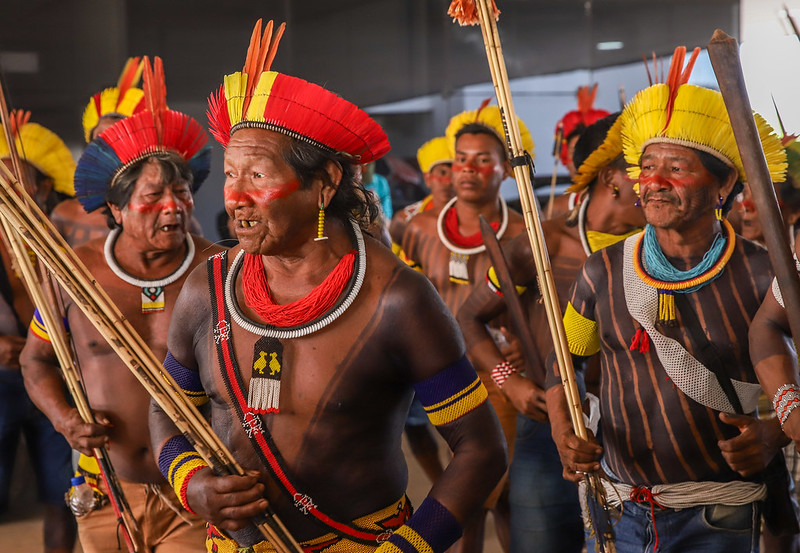
Indigenous Delegates Head to COP30 with Bold Climate Demands
As the city of Belém in Brazil prepares to host COP30, the 2025 United Nations climate conference, more than 3,000 Indigenous delegates from across Latin America, Africa, Asia, and the Pacific are poised to attend. This marks the largest Indigenous participation in the history of the COP series, and expectations are high for policy changes focused on justice, land rights, and direct climate finance.
Scheduled from November 10–21, COP30 is being dubbed the “nature COP” due to its emphasis on nature-based solutions and the role of forests in combating climate change. Indigenous leaders emphasize that protecting their lands should be central to these strategies.
Demands for Recognition and Inclusion
“Upholding Indigenous peoples’ rights is only possible by placing them at the center of discussions, negotiations, and decision-making,” said Dinaman Tuxá, executive coordinator of the Articulation of Indigenous Peoples of Brazil (APIB). He stressed the need for land demarcation and direct financing as essential tools for mitigating global warming.
At the COP30 World Leaders Summit on November 6, prior to the main event, nations made pledges to recognize 160 million hectares of customary lands and committed $1.8 billion toward land rights and climate finance. These pledges are seen as a step toward fulfilling Indigenous demands but must be followed by concrete action during the conference.
Barriers to Participation
Despite the increased presence, many Indigenous leaders are struggling to attend due to high accommodation costs in Belém. Gideon Sanago, a Maasai leader from Tanzania, noted that logistical hurdles have prevented many African delegates from participating. “Many leaders couldn’t access the registration systems or secure lodging, which is discouraging,” he said.
Delegates from Honduras, like Garifuna leader Gregoria Jimenez, also expressed concerns. Jimenez highlighted the need for Afro-descendant communities to be involved in energy transition discussions and called for Honduras to adopt the Escazú Agreement to protect environmental defenders.
Underrepresentation from Asia-Pacific
Asia and the Pacific regions remain underrepresented in climate talks, despite being home to the majority of the world’s Indigenous population. Rukka Sombolinggi of Indonesia’s Indigenous Peoples Alliance of the Archipelago (AMAN) emphasized the need for visibility. “We guard the world’s biodiversity and must be included in decisions affecting our ecosystems,” she said.
Climate Solutions Centered on Indigenous Rights
Most countries have yet to submit updated Nationally Determined Contributions (NDCs) under the Paris Agreement. Brazil submitted its updated NDC in 2024, and more than 100 countries are expected to follow suit by COP30. While renewable energy is central to these plans, Tuxá warned that energy transitions often lead to increased mining on Indigenous lands, posing new threats.
One key initiative expected to launch is the Belém Action Mechanism (BAM), aimed at promoting a just energy transition. This builds on the Just Transition Work Programme (JTWP) established at COP27. Tuxá insisted that demarcating Indigenous lands should be considered a global climate goal, not just a national one.
Forest Protection and Climate Goals
Recent research highlights that Indigenous-managed lands significantly reduce deforestation and carbon emissions. Strengthening land rights could prevent up to 20% of additional deforestation and 26% of emissions by 2030. Governments of Brazil, Peru, and Norway have pledged to support the recognition of 160 million hectares of Indigenous land through the Intergovernmental Land Tenure Commitment.
Indonesia also announced a plan to recognize 1.4 million hectares of customary forests, a move welcomed by Indigenous leaders.
Calls for Broader Ecosystem Protection
Deborah Sanchez from the Rights and Resources Initiative emphasized the need to go beyond forests. “Indigenous peoples also protect grasslands and other ecosystems vital for carbon storage,” she noted.
Puyr Tembé, an Indigenous leader from Brazil’s Pará state, called for binding protections for forest defenders. In 2024 alone, 146 environmental defenders were killed or went missing, often in conflicts over land and resources.
Financial Commitments and Accountability
At the summit, the Forest Tenure Funders Group renewed their $1.7 billion pledge, increasing it to $1.86 billion over five years. The Tropical Forest Forever Facility (TFFF) was also launched, requiring 20% of payments to go directly to Indigenous and local communities.
Juan Carlos Jintiach of the Global Alliance of Territorial Communities hailed this as a “historic victory.” However, he warned that funds must be managed transparently and be accessible to communities without bureaucratic delays.
Gender Equity and Direct Access
Cécile Bibiane Ndjebet, founder of the African Women’s Network for Community Management of Forests, pointed out that Indigenous women still face significant barriers to climate finance. “We need mechanisms that allow women to access funds directly,” she said.
Fred Launay of Panthera highlighted the need for a financial shift that values the relationship between communities and biodiversity. “We must stop funding activities that destroy nature,” he said.
Urgent Need for Adaptation Funding
Many Indigenous leaders stressed the urgency of climate adaptation funding. The goal of doubling adaptation finance to $40 billion by 2025, set during COP26, is unlikely to be met. Of the $768.4 million pledged for the Fund for Responding to Loss and Damage at COP28, only $321 million has been delivered.
Rukka Sombolinggi emphasized that without adaptation and loss and damage funding, Indigenous communities cannot cope with the worsening climate crises such as floods, wildfires, and droughts.
Looking Ahead
At COP30, countries are expected to outline a roadmap for the New Collective Quantified Goal (NCQG), aiming to mobilize $300 billion annually for developing countries by 2035. Indigenous leaders like Leo Cerda from Ecuador say the goal must balance mitigation and adaptation, and recognize the human and cultural dimensions of climate action.
“It’s not just about carbon,” Cerda said. “It’s about lives, heritage, and resilient territories.”
This article is inspired by content from Original Source. It has been rephrased for originality. Images are credited to the original source.