

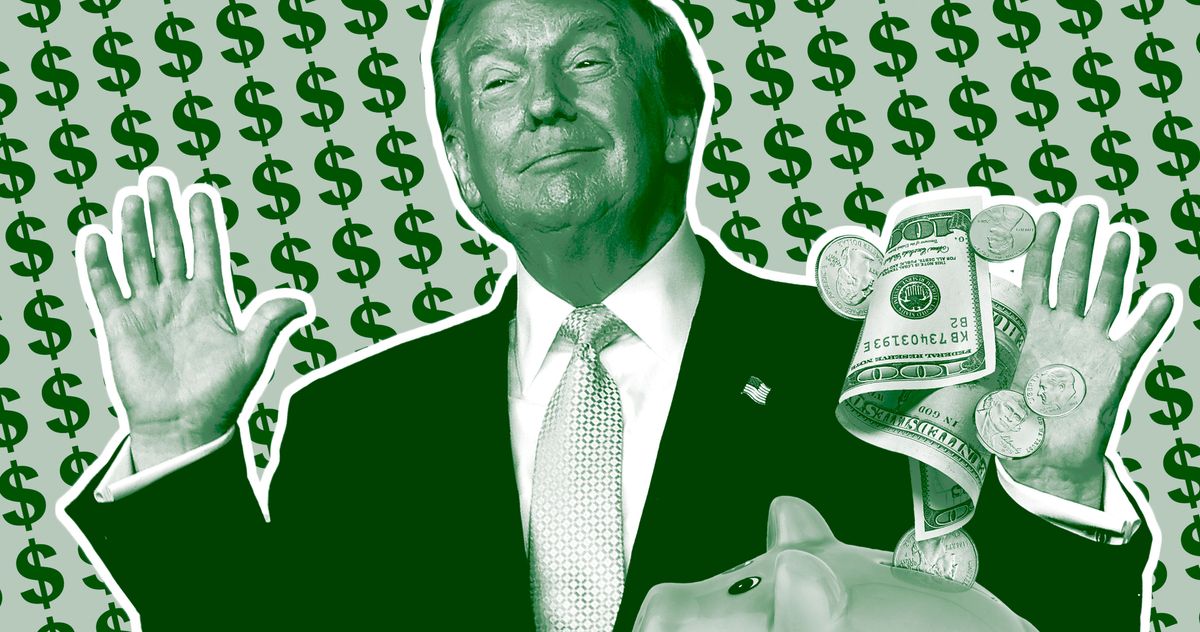
Trump Accounts: A New Financial Tool for Babies
In 2025, a new government program called “Trump accounts” will provide $1,000 to every newborn American child, regardless of parental income. Established by the Big Beautiful Act, these accounts are designed as individual retirement accounts (IRAs) for children, aiming to foster long-term financial growth. While the initiative is framed as a pro-family policy, parents are grappling with mixed emotions about its implications.
Sarah, 32, found out about the program shortly after becoming unemployed. “It felt like such a slap in the face,” she said, referring to the irony of losing her job due to funding cuts by the Trump administration, only to be offered money for her unborn child through a program carrying Trump’s name. Sarah is due to give birth in January 2025, but the accounts won’t be accessible until July 2026, when parents can elect to open one during their 2025 tax filings.
How Trump Accounts Work
The Internal Revenue Service (IRS) states that any child born between January 2025 and December 2028 with a valid Social Security number is eligible for the $1,000 seed funding. Contributions of up to $5,000 annually can be made by anyone, including parents and employers. Notably, employers can contribute an additional $2,500 per year, which won’t count as taxable income but will apply to the $5,000 cap.
The White House asserts that if maximum contributions are made annually, a child born in 2026 could accumulate approximately $303,800 by age 18 and surpass $1 million by age 28. Trump described the accounts as a “pro-family initiative that will help millions of Americans harness the strength of our economy.”
Mixed Reactions from Parents
Despite the potential for long-term growth, many parents express ambivalence. Some are unaware of the program, while others, like Julie, 29, are skeptical. “We talked to our financial adviser and ultimately decided that, sure, we’ll take free money for our daughter,” she said. However, she has no plans to contribute beyond the initial $1,000. “There’s no special tax benefit. I’d rather invest in a 529 account.”
Julie’s sentiment is echoed by financial experts. Certified public accountant Orumé Hays highlights that the account is only worthwhile if a child qualifies for the free seed money or if employers are contributing. “Otherwise, if you have money to invest, Trump accounts are not the most effective way to do it,” she said.
Limitations and Restrictions
Trump accounts come with several caveats. Contributions are not tax-deductible, and funds must be invested in index-tracking funds, such as those following the S&P 500. Access is restricted until the child turns 18, at which point the account functions similarly to a traditional IRA. Withdrawals for education, medical expenses, or a first home are permitted, but unqualified withdrawals incur a 10 percent tax penalty in addition to regular income tax.
Meg K. Wheeler, founder of the Equitable Money Project, argues that parents would be better served with more flexible investment options, such as a regular brokerage account or a 529 plan, which offer tax advantages and fewer restrictions. “I’ve had a lot of people say, ‘I’m nervous to put my money into it because I don’t know if I’m going to be able to get it out,’” Wheeler said.
Historical Context and Political Origins
Interestingly, the concept behind Trump accounts is not new or uniquely Republican. Economists Darrick Hamilton and William Darity proposed a similar “Baby Bonds” idea in 2010 to help close the racial wealth gap. In 2023, Democratic lawmakers Cory Booker and Ayanna Pressley introduced the American Opportunity Accounts Act, which also proposed $1,000 seed savings accounts for newborns, with additional contributions based on family income.
Financial executive Brad Gerstner of Altimeter Capital played a key role in getting the Trump administration on board after initially pitching the idea to the Biden administration. Trump’s affinity for branding — similar to the stimulus checks bearing his name — likely influenced his support.
Financial Experts Weigh In
Financial educator Mal Baska, who had her second child in 2023, plans to open a Trump account only for her newborn to receive the free $1,000. “These accounts don’t present any greater advantages than what I already have set up for my kids,” she explained. Baska and other experts note that while the intentions may be admirable, the execution falls short.
Wheeler emphasized that most American parents lack the extra funds to contribute meaningfully to these accounts. She advises prioritizing personal retirement savings, which are often more beneficial and come with tax deductions. Based on a 7 percent return, the $1,000 could grow to about $3,000 in 18 years and $58,000 in 60 years — before taxes. “That’s better than nothing,” Wheeler said, “but not nearly as impactful as investing in immediate social support programs.”
Is It Worth It?
For parents like Sarah, the decision remains fraught. “I’ll probably take the money for my daughter, even though I’m deeply opposed to the legislation,” she said. Now employed again, albeit at a lower salary, she questions the program’s priorities. “Kids are losing their SNAP benefits and going hungry, but they get $1,000 they can’t touch? Come on.”
Wheeler agrees, calling it a “major misallocation of public funds.” She warns that the program may not have lasting power, especially given concerns about the reliability of government oversight. “So sure, take your $1,000 if it’s offered to you,” she said, “but this tool is highly problematic. And I don’t know if it’s going to stick around — frankly, I don’t think it should.”
This article is inspired by content from Original Source. It has been rephrased for originality. Images are credited to the original source.