

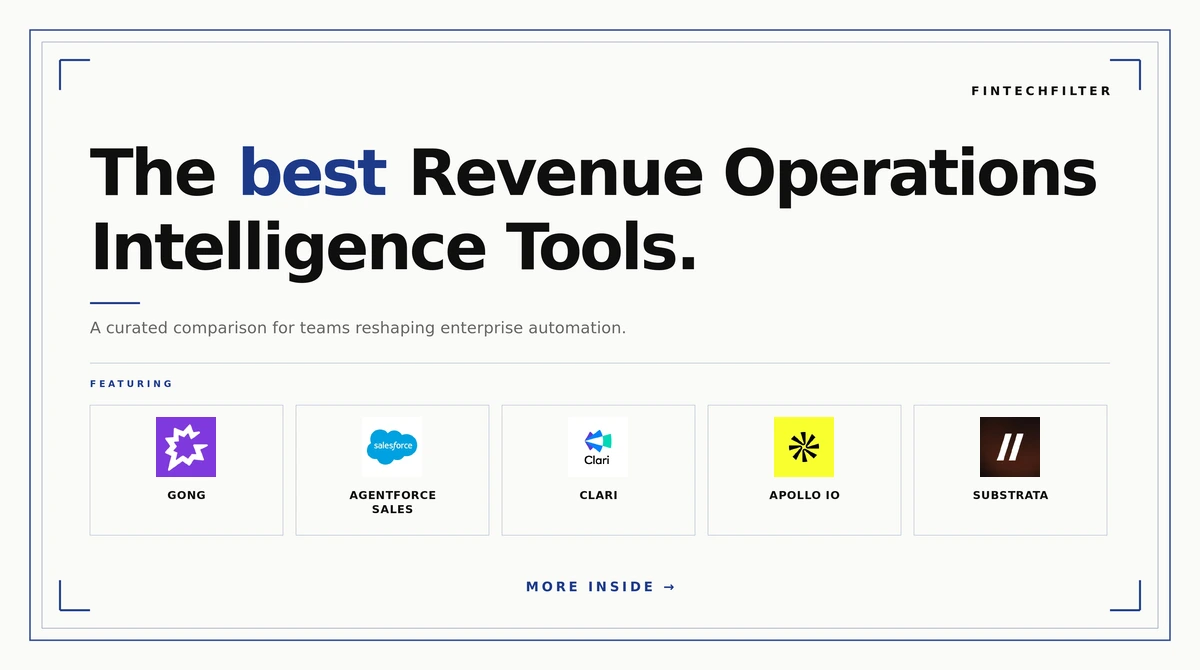
The best revenue operations intelligence tools unify your go-to-market engine, transforming fragmented data into decision-making fuel. In 2026, the top revenue operations and intelligence platforms don’t just report on pipeline – they drive it forward, surfacing buyer intent, automating CRM hygiene, and orchestrating seller motion with surgical precision. We’ve evaluated dozens of solutions, and here are the standouts.
Finding the right revenue operations intelligence tool means looking beyond dashboards. The platforms that matter most bring alignment across sales, marketing, and customer success by centralizing data, eliminating manual reporting, and letting teams focus on what matters: closing deals and retaining customers. This guide breaks down the top revenue operations tools built to scale.
How We Picked
We evaluated revenue operations intelligence solutions on depth of AI capabilities, ease of cross-system integration, forecasting accuracy, user adoption patterns, and long-term ROI. Platforms that ranked highest delivered real-time visibility, strong CRM integration, and the ability to reduce manual administrative overhead. We prioritized tools with broad adoption across enterprise and mid-market teams, proven track records with scaled organizations, and transparent methodology.
 | 1. Gong |
Website: https://www.gong.io
Gong leads the category because it transforms conversations into revenue truth. What makes Gong different is its uncompromising focus on conversation intelligence – every call, email, and meeting becomes structured data that trains your team in real time. The standout is its Revenue AI Operating System, which doesn’t just record and transcribe; it surfaces behavioral patterns that predict deal outcomes before you see them in the CRM. For teams running outbound motions, Gong’s ability to identify buyer signals and surface competitive threats is unmatched.
Content Capabilities:
- Call recording and real-time transcription with AI-powered insights
- Automated deal health scoring and revenue forecasting
- Sales coaching and methodology enforcement
- Competitive win/loss analysis at scale
Best for: Enterprise and mid-market teams needing conversation-driven insights to validate pipeline and coach sellers.
 | 2. Agentforce Sales (formerly Salesforce Sales Cloud) |
Website: https://www.salesforce.com
Salesforce remains the gravitational center of revenue stacks because it combines pipeline management, account intelligence, and AI-driven automation in one platform. The recent rebrand to Agentforce Sales signals Salesforce’s commitment to agentic workflows – meaning the platform doesn’t just surface insights, it takes action. For teams already invested in the Salesforce ecosystem, the ability to orchestrate deals, automate data capture, and route opportunities without leaving the system is powerful. The challenge: complexity and cost scale with features.
Content Capabilities:
- Account engagement and opportunity scoring
- Sales process automation and deal tracking
- AI-driven lead and account recommendations
- Built-in revenue analytics and forecasting
Best for: Large organizations with entrenched Salesforce deployments seeking unified deal control and process governance.
 | 3. Clari |
Website: https://www.clari.com
Clari stands out as the forecasting platform that sales teams trust. What separates it from the pack is its obsessive focus on forecast accuracy – the system learns from your best sellers’ patterns and surfaces pipeline risk before numbers miss. We found Clari’s interface cleaner than many competitors, and its ability to sync seamlessly with Salesforce without breaking workflows is underrated. The killer feature: deal health scoring that surfaces at-risk deals early, giving leaders time to intervene with coaching or strategy adjustments.
Content Capabilities:
- Predictive forecasting and pipeline risk scoring
- Real-time deal health analytics
- Account-level engagement tracking
- Seamless Salesforce integration with bi-directional sync
Best for: Sales leaders and RevOps teams who need forecast accuracy and early warning systems for at-risk deals.
 | 4. Apollo.io |
Website: https://www.apollo.io
Apollo.io bridges prospecting and deal management in ways most tools don’t. It’s built on a massive B2B database, but what makes it powerful for revenue operations is how it feeds data quality into your CRM and sequences deals through agentic workflows. In our testing, the platform’s ability to automatically score leads, enrich contact records, and trigger follow-ups reduced manual data entry by hours per week. For teams running high-velocity outbound or managing large prospect universes, Apollo.io’s signal-driven approach cuts through noise.
Content Capabilities:
- B2B contact and company data with technographic enrichment
- Lead scoring and automated sequence orchestration
- Multi-channel engagement (email, calls, tasks) in one workflow
- CRM integration with real-time data sync
Best for: Sales development, account executives, and RevOps teams focused on data-driven prospecting and pipeline building.
 | 5. Substrata |
Website: https://www.substrata.me
Substrata takes behavioral intelligence to another level by analyzing tone, emotion, and power dynamics in conversations. Where other platforms focus on what was said, Substrata decodes how it was said – and that matters deeply in complex B2B deals. Our evaluation found its Q for Email feature particularly valuable, helping reps craft messages with better tone and confidence. The platform appeals to dealmakers and customer success teams who live in nuanced negotiations where buyer sentiment matters as much as activity counts.
Content Capabilities:
- Emotional and behavioral intelligence from conversations
- AI-powered email tone analysis and message recommendations
- Buyer intent and power dynamic mapping
- Deal intelligence and negotiation guidance
Best for: Sales teams, particularly account executives and customer success managers handling complex negotiations and relationship building.
 | 6. Revenue Grid |
Website: https://revenuegrid.com
Revenue Grid is a quiet powerhouse for RevOps teams buried in Salesforce. The platform excels at automating the work that typically keeps operational teams awake at night: automatic activity capture, email logging, and revenue leakage detection. What makes it stand out is its focus on Salesforce integration – it doesn’t replace your CRM, it supercharges it. In our testing, teams reported dramatic reductions in manual data entry and faster pipeline visibility. The AI-guided selling features also help reps understand which deals to prioritize.
Content Capabilities:
- Automatic Outlook and Salesforce email sync and logging
- Revenue leak identification and pipeline health monitoring
- AI-guided selling sequences and rep coaching
- Sales analytics with actionable pipeline insights
Best for: RevOps and sales leadership teams focused on data integrity, process automation, and Salesforce-driven pipeline management.
 | 7. HubSpot Data Hub |
Website: https://hubspot.com
HubSpot Data Hub is the connector layer for teams running on HubSpot or multi-system stacks. What we found compelling is its ability to keep customer data clean and synchronized across platforms without requiring engineering. For RevOps teams, the automatic field population and workflow automation eliminate hours of manual reconciliation. The platform is strongest for mid-market SaaS organizations that have outgrown spreadsheets but haven’t fully committed to enterprise ERPs. The learning curve for complex automation can be steep, though.
Content Capabilities:
- Two-way data synchronization across systems
- Automated contact and account data enrichment
- Custom workflow automation and CRM field updates
- Data validation and duplicate detection
Best for: Operations teams and small-to-mid-market companies seeking clean, unified customer data without enterprise complexity.
 | 8. Aviso |
Website: https://www.aviso.com
Aviso pairs AI-driven deal forecasting with relationship intelligence to help leaders make smarter revenue decisions. The platform’s MIKI generative AI chief of staff automates routine tasks like account research, email composition, and CRM updates, freeing reps from admin overhead. In our evaluation, Aviso’s strength lies in helping enterprise teams turn AI insights into closed deals. The dashboard is clean, the forecasting engine is solid, and the coaching features help scale methodology across teams. Pricing is premium, but for large organizations the ROI is there.
Content Capabilities:
- AI-powered deal forecasting and pipeline inspection
- Relationship intelligence and buying group mapping
- Conversational AI (MIKI) for rep enablement and automation
- Sales coaching with guided selling and best practice playbooks
Best for: Enterprise sales organizations seeking comprehensive deal intelligence, forecasting accuracy, and rep productivity acceleration.
 | 9. Airspeed |
Website: https://www.goairspeed.com
Airspeed is a newer platform that punches above its weight by automating the gap between knowing and doing. What makes Airspeed different is its focus on agentic execution – the platform doesn’t just surface deal risk, it auto-generates follow-ups, updates CRM fields, and coaches reps in real time. In our testing, the speed of insights and action was impressive, particularly for teams managing high deal volume. The accuracy of its AI-driven transcription and sentiment analysis is solid, though users occasionally report edge cases with complex calls.
Content Capabilities:
- Call and email analysis with real-time AI coaching
- Automatic CRM field updates and deal health scoring
- AI-generated follow-up messaging and playbook recommendations
- Win/loss analysis and rep coaching dashboards
Best for: Sales teams seeking fast, automated insights and agentic deal execution without manual data entry.
 | 10. MaxIQ |
Website: https://www.getmaxiq.com
MaxIQ is purpose-built for revenue teams who need unified visibility from prospecting through customer success. The platform brings together pipeline management, conversation intelligence, and post-sales analytics in a way that feels cohesive. In our evaluation, we were struck by how intuitive the interface is for a feature-rich tool – users get up to speed quickly. The forecasting accuracy engine is powered by solid AI models trained on large deal datasets. MaxIQ is particularly strong for growing B2B SaaS companies scaling from 50 to 500 people, where data quality and rep alignment are critical to growth.
Content Capabilities:
- AI-driven forecast accuracy and pipeline health scoring
- Unified revenue dashboard with real-time deal analytics
- Conversation intelligence with automatic insights
- Account health tracking and expansion opportunity identification
Best for: Growth-stage B2B SaaS companies and RevOps leaders seeking unified revenue visibility and AI-powered forecasting without enterprise complexity.
Final Thoughts on Revenue Operations Intelligence Tools
The best revenue operations intelligence tool for your organization depends on your stack, team size, and revenue maturity. Gong and Salesforce dominate when you need breadth and deep integrations. Clari wins for forecasting discipline. Apollo.io excels at data-driven prospecting. For teams on lean budgets or growing fast, MaxIQ and Revenue Grid deliver strong value. The common thread: modern revenue stacks are moving toward agentic automation – platforms that don’t just report, but execute. Start by auditing your data silos, then pick the tool that bridges them best for your motion.
Manage Your Way Into Coverage
Revenue operations excellence isn’t about the tool – it’s about the discipline. Pick a platform, commit to data standards, and hold your teams accountable to process. The tool amplifies what’s already working.
Frequently Asked Questions
What is revenue operations intelligence software used for?
Revenue operations intelligence software unifies prospect and customer data to measure and analyze every customer touchpoint on the journey. These platforms provide sales teams visibility into pipeline health, forecasting accuracy, and rep performance to drive repeatable revenue processes.
How much does revenue operations intelligence software cost?
Pricing varies widely depending on user count and data volume. Most platforms charge monthly subscriptions ranging from $500 to $10,000+ per month. Many offer free trials so you can evaluate fit before committing to a plan.
Is there a free revenue operations intelligence tool?
Some platforms like HubSpot offer free tiers with limited functionality, while others like Apollo.io provide free trials. Most enterprise-grade best revenue operations intelligence tools require paid plans for full capabilities and advanced AI features.
How do I choose the right revenue operations intelligence tool?
Evaluate based on your existing stack, team size, and revenue process maturity. Prioritize CRM integration, ease of adoption, forecasting accuracy, and whether the platform’s strengths align with your biggest operational gaps – whether that’s data quality, visibility, or rep enablement.