

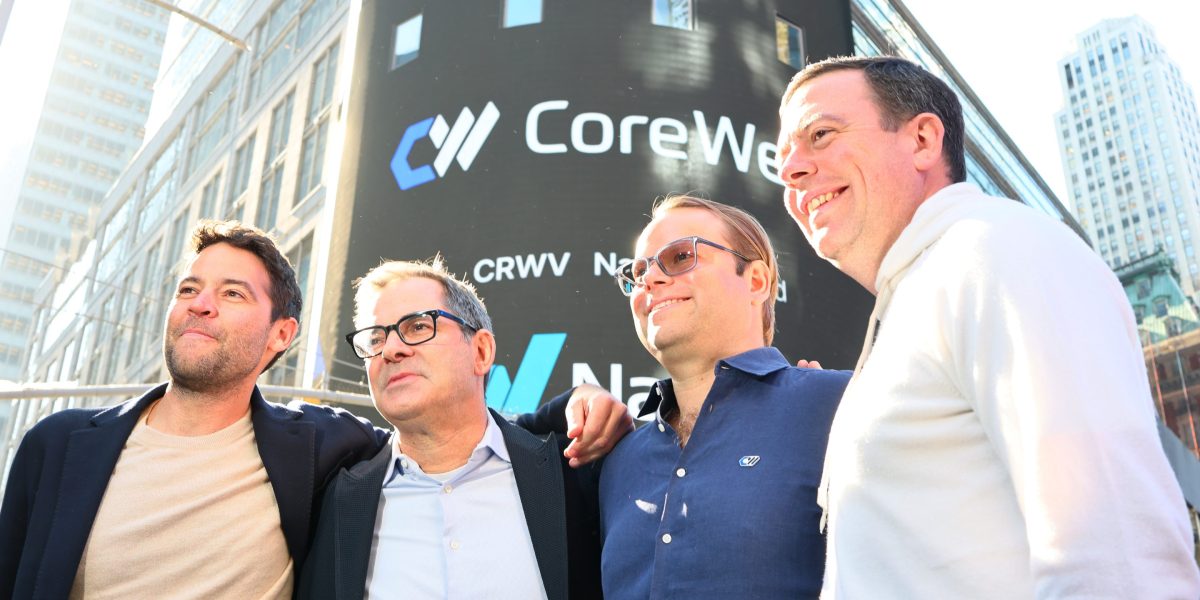
CoreWeave at the Center of AI Infrastructure Expansion
CoreWeave, a rapidly growing data-center operator, has emerged as a key player in the artificial intelligence (AI) revolution. Its sprawling facilities, like the $1.6 billion data center in Plano, Texas, power the computational needs of AI giants such as Microsoft and OpenAI. Yet despite its meteoric rise, CoreWeave’s financial foundation is raising red flags for analysts and investors alike.
The company does not own most of its data centers, relying instead on leasing and a mountain of debt to fuel its expansion. CoreWeave has positioned itself as a provider of critical infrastructure during the AI boom, but its $11 billion in debt and $7.6 billion in short-term liabilities vastly outweigh its 2024 revenue of $1.9 billion. For 2025, CEO Michael Intrator projects revenues between $5.15 billion and $5.35 billion, but with capital expenditures expected to reach $23 billion, concerns over sustainability persist.
A Business Model Built on Borrowing
CoreWeave’s business strategy relies heavily on borrowed capital to build data centers and purchase GPUs. These assets are then rented to AI firms needing massive computing power. However, the company’s balance sheet reveals high-interest debt with significant near-term obligations. Two of CoreWeave’s largest loans, totaling $6.8 billion, carry interest rates of 11% and 15%, with principal payments set to begin in early 2026.
Beyond its current debt, CoreWeave has $34 billion in lease obligations scheduled through 2028. Many of these commitments pertain to facilities not yet operational, exposing the company to potential contract cancellations in the event of delays or customer defaults.
Investors Divided on CoreWeave’s Future
Analysts are split on CoreWeave’s prospects. While 14 out of 26 equity analysts rate the stock as a buy or outperform, others issue cautionary notes. Critics argue that CoreWeave’s returns are insufficient to justify its capital outlay. With razor-thin operating margins—just 1.6% last quarter—and over $600 million in losses during the first half of 2025, skeptics question whether growth can outpace costs.
Gil Luria of D.A. Davidson predicts that CoreWeave may face bankruptcy within five years unless it significantly boosts profitability or restructures its debt. Kerrisdale Capital, which holds a short position in the company, labels it “the poster child of the AI infrastructure bubble.”
Revenue Pipeline and Risk Exposure
CoreWeave has announced $30 billion in remaining performance obligations (RPOs), half of which it expects to realize within two years. However, with low margins, even $7.5 billion in near-term revenue would generate limited income—insufficient to cover interest payments or loan repayments.
Furthermore, CoreWeave’s customer base is highly concentrated. In Q2 2025, a staggering 71% of its revenue came from Microsoft. While Microsoft’s financial health is not in question, analysts worry about future contract renewals as the tech giant builds its own data centers. OpenAI, another major client, has also committed substantial sums to other infrastructure partners, which could deprioritize CoreWeave in tough times.
Origins in Crypto and Expansion into AI
CoreWeave began as a cryptocurrency mining venture before pivoting to AI infrastructure. Early funding from Magnetar Capital allowed the company to stockpile Nvidia GPUs, which later became instrumental in meeting AI demand. Since then, it has secured billions more in funding, enabling its expansion across the U.S. and U.K.
Following its IPO in March 2025, CoreWeave’s stock surged 160%, buoyed by a 420% quarterly revenue increase. Despite a recent dip, shares remain well above their debut price, reflecting investor optimism tempered by financial caution.
Recent Setbacks and Future Prospects
In October, CoreWeave faced a setback when Core Scientific’s shareholders rejected its $9 billion acquisition offer. The deal was aimed at consolidating data center capacity, but CoreWeave walked away with a $270 million breakup fee. Despite the failed merger, CoreWeave remains obligated to pay Core Scientific $10 billion over the next 12 years for leased capacity.
Still, bulls argue that the company is well-positioned for long-term success. Kevin Dede of H.C. Wainwright views CoreWeave’s growth trajectory as a strategic play in a supply-constrained market. Analyst Thomas Blakely from Cantor Fitzgerald compares the current AI moment to the early smartphone era, with CoreWeave poised as a foundational player.
Blakely believes that once CoreWeave’s infrastructure is paid off, its revenue will increasingly come from assets already on its books, improving margins. He also points to recent deals with Meta and Poolside as signs of a diversifying customer base and growing demand that could help the company achieve scale and profitability.
The Earnings Report: A Key Test
All eyes are on CoreWeave’s upcoming earnings report. Investors will scrutinize its RPO growth, revenue forecasts, and any updates on debt restructuring or new equity raises. The company’s ability to manage its financial obligations while continuing to grow will determine whether it fulfills its promise or becomes a cautionary tale of the AI era.
Despite its risks, CoreWeave represents a bold bet on the future of AI. If it can navigate its financial tightrope and convert potential into performance, it may yet become a cornerstone of the next technological revolution.
This article is inspired by content from Original Source. It has been rephrased for originality. Images are credited to the original source.