

South Korean Won Plunges to Levels Last Seen in Global Financial Crisis
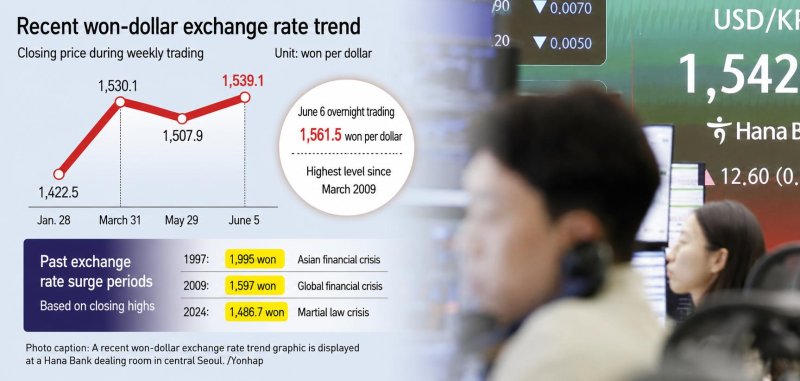
The won-dollar exchange rate has become a focal point of concern for global investors and policymakers, as the South Korean won weakened sharply against the U.S. dollar this week. The rate reached 1,561.5 won per dollar in overnight trading early Friday, marking its lowest level in more than 17 years—last witnessed during the height of the global financial crisis in March 2009.
This dramatic shift in the won-dollar exchange rate is attributed to a combination of internal and external pressures, including sustained foreign investor outflows from Korean equities, uncertainty in global markets due to the prolonged Middle East war, and a strengthened U.S. dollar amid robust economic data.
Foreign Investors Drive Won Weakness
One of the primary factors behind the weakening of the South Korean won is the persistent selling by foreign investors in the domestic stock market. According to market data, foreign investors have been net sellers of Korean equities for 20 consecutive trading days. Their total divestment this year has approached 120 trillion won (approximately $77 billion USD), significantly increasing demand for U.S. dollars and putting upward pressure on the won-dollar exchange rate.
This trend is further compounded by global risk aversion, as investors seek safe-haven assets amid geopolitical instability. The ongoing Middle East conflict has heightened uncertainty, leading market participants to favor the dollar over emerging market currencies like the won.
U.S. Economic Strength Bolsters Dollar
The U.S. dollar’s recent surge can also be traced to stronger-than-expected American labor market data. The Wall Street Journal Dollar Index climbed this week following robust jobs figures, reinforcing expectations that the Federal Reserve may adopt a more hawkish monetary policy stance. Such a move would likely increase interest rate differentials between the U.S. and South Korea, making dollar-denominated assets more attractive and intensifying the pressure on the won-dollar exchange rate.
Additionally, higher U.S. Treasury yields are drawing capital away from emerging markets, exacerbating the challenges faced by the won.
Inflation and Policy Response in South Korea
Domestically, inflationary pressures are mounting. South Korea’s consumer price inflation in May reached 3.1%, the highest in over two years, driven largely by elevated petroleum prices linked to the Middle East conflict. Rising inflation has put additional strain on the won and prompted policymakers to consider their next steps.
Bank of Korea Governor Hyun Song Shin recently noted that the central bank would need to consider raising the benchmark interest rate, citing exchange rate volatility, rising housing prices in Seoul, and mounting household debt as key factors. Market watchers are closely monitoring whether the Bank of Korea will act to stabilize the currency and contain inflation.
Government and Regulatory Actions
In response to the recent market turbulence, Deputy Prime Minister and Finance and Economy Minister Koo Yun-cheol convened an emergency meeting with regulatory agencies. The government has pledged to enhance transparency in offshore non-deliverable forward (NDF) derivative transactions—a segment where one-sided movements have been linked to increased market volatility. Authorities also plan to scrutinize and curb speculative activities that may be exploiting the won’s weakness.
The Financial Supervisory Service and Bank of Korea are set to intensify inspections for any market-disrupting behavior, aiming to restore confidence and stability in the foreign exchange market.
Outlook for the Won-Dollar Exchange Rate
Looking ahead, the direction of the won-dollar exchange rate will hinge on several factors. Continued foreign investor selling, the trajectory of U.S. monetary policy under Federal Reserve Chair Kevin Warsh, and evolving geopolitical developments—particularly in the Middle East—will all play significant roles.
The Korea Trade Insurance Corp. has emphasized in its June outlook that persistent foreign outflows and sustained dollar strength could keep the won under pressure. Policymakers remain vigilant, prepared to act swiftly should further instability arise.
Conclusion: Market Volatility Likely to Persist
The recent decline in the won-dollar exchange rate underscores the interconnected nature of global markets. As South Korea grapples with both external shocks and domestic challenges, all eyes remain on policymakers and market participants for cues on the currency’s next moves. Vigilant monitoring and coordinated responses will be crucial as volatility is expected to continue in the near term.
This article is inspired by content from Original Source. It has been rephrased for originality. Images are credited to the original source.